
IBR plan: Income-Based Repayment
With the IBR plan, you pay 10% or 15% of your discretionary income. After 20 or 25 years, whatever remains is forgiven. The plan remains open for any loan issued before July 1, 2026.
- The shielded amount equals 150% of the poverty guideline
- For a single person, $23,940 is shielded
- There's a cap, and the bill never goes above the 10-year Standard bill
Explaining the income-based repayment program
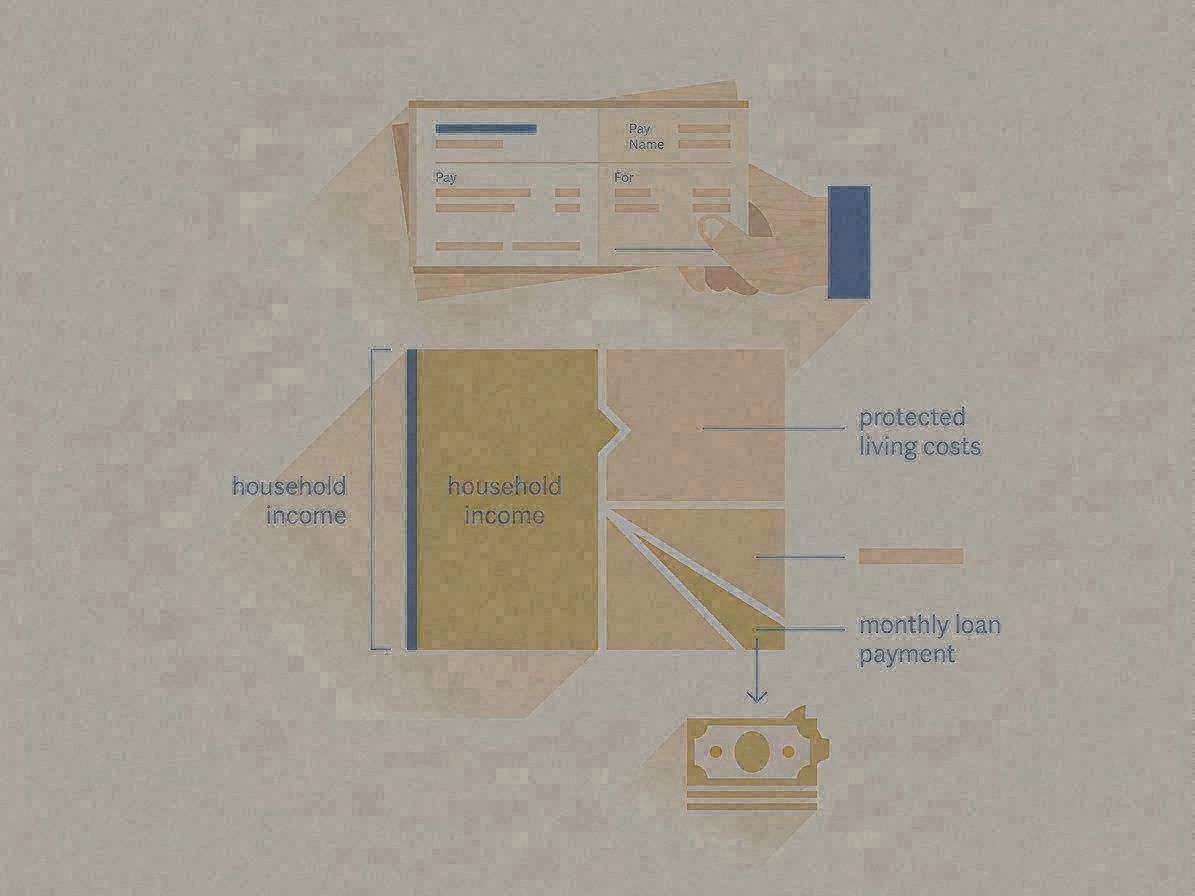
Income-Based Repayment bases your bill on what you earn rather than what you owe. Your payment equals a share of your discretionary income. Subtract 150% of the federal poverty guideline based on your family size from your AGI. For one person in 2026, 150% of the guideline equals $23,940.
How discretionary income determines your student loan payment
When you first borrowed determines your share.
| Borrowed before July 1, 2014 | Borrowed July 1, 2014 or later | |
|---|---|---|
| Share of discretionary income | 15% | 10% |
| Years to forgiveness | 25 years | 20 years |
| Payment cap | Never above the 10-year Standard payment | Never above the 10-year Standard payment |
The 10-year Standard payment is the most your bill can reach. RAP and ICR payments have no 10-year Standard amount cap.
An example using real numbers
Dana earns $48,000 each year and is single. Because she first borrowed in 2016, she pays 10%. Each month, her IBR bill is about $200. Under RAP, she'd pay about $160. Run your own figures through the IBR calculator.
When student loans are forgiven after 20 or 25 years
Borrowers who started on or after July 1, 2014 receive forgiveness after 20 years. Those who borrowed earlier wait 25 years. If you make 120 qualifying monthly payments while you work full-time at an eligible employer, PSLF forgives your remaining Direct Loan balance. An IDR discharge after 2025 could lead to federal tax, unless you met the payment milestone before Jan. 1, 2026.
Who can sign up now?
For borrowing before July 1, 2026, IBR stays open. When a loan's first payout is dated July 1, 2026 or later, all Direct Loans are limited to Tiered Standard or RAP. PAYE and ICR will end no later than July 1, 2028. Many PAYE and ICR borrowers switch to IBR because of this.
IBR compared with RAP
IBR leaves out part of your income when calculating your bill. RAP charges a share of your full AGI instead. For each dependent, RAP subtracts $50, and the payment never falls below $10. There's no cap under RAP, but forgiveness takes 30 years. If you switch back, payments made under RAP don't count toward IBR, ICR or PAYE discharge. Compare RAP and IBR side by side.
How to apply for the IBR plan
Use your FSA ID to sign in at studentaid.gov.
Go to the income-driven repayment application and select IBR there.
Give the Department of Education permission to pull your tax data. This enters your income for you.
Enter your family size and your tax filing status.
Submit it. Your servicer sends your new payment amount in a letter.
Guides related to this topic
Common questions
Does income-based repayment work well for federal student loans?
When your income is low compared with your debt, it's a strong pick. If your pay rises a lot, the cap protects you too.
Will the IBR plan still be available?
Yes, there is one. IBR accepts loans taken out before July 1, 2026. The plans that close are PAYE and ICR.
Does IBR offer forgiveness after 20 or 25 years?
If your first loan came on July 1, 2014 or later, forgiveness takes 20 years. Borrowing before that date means 25 years.
Does a new income-based repayment plan exist?
Yes, there is one. RAP bases your bill on your AGI and opened on July 1, 2026. For borrowing before July 1, 2026, IBR stays open.
Sources: Federal Student Aid, IDR questions, Federal Student Aid, IDR updates, HHS poverty guidelines.